Our Jun2Aug Internship Batches are open. Join Now!


Table of Contents
Keyword research for blogging helps you find topics people actually search for, so you stop guessing what to write next. The best approach is simple : choose keywords by intent, difficulty, and content fit, not just by search volume.
Quick summary : Start with a seed topic, check what the searcher wants, compare competition, and choose topics you can realistically cover well. That is the foundation of a beginner-friendly keyword workflow.
What Is Keyword Research for Blogging?
Keyword research for blogging is the process of finding search terms your audience uses, then choosing the ones that best fit your blog. It helps you create content that matches real demand instead of publishing random ideas. When done well, it gives every post a clearer purpose and a much better chance of attracting the right readers.
A good keyword is not only popular. It must also match your topic, your reader’s intent, and your site’s current ability to compete. That is why many SEO guides now recommend prioritizing relevance and intent before volume. In practice, this means choosing keywords that you can answer well, support with helpful examples, and connect naturally to your site’s overall theme.
Why Does Keyword Research Matter?
Keyword research for blogging matters because it tells you what to write, how to frame it, and where to focus your effort. Without it, you may publish content that gets ignored or attracts the wrong audience. It also helps you avoid guessing, because every blog post starts with a clearer purpose and a better chance of matching what readers actually want.
A recent keyword strategy guide from Ahrefs and other SEO resources emphasizes that a keyword should feel like a real question with a job behind it. That means one keyword can lead to traffic, but the right keyword can also lead to trust, leads, and sales. When you choose keywords well, you are not just chasing clicks — you are building content that serves a specific need and supports your blog’s growth over time.
How Do You Choose a Good Keyword?
Choose a good keyword by checking three things: intent, difficulty, and content fit. Search volume matters, but it should not be your first filter. A keyword with big numbers may still fail if it does not match what the reader actually wants or if it is too competitive for your site.
- Intent : What does the searcher want right now?
- Difficulty : Can your site realistically compete?
- Content fit : Can you answer the topic well and better than the alternatives?
This approach aligns with current keyword intent guidance and beginner SEO workflows. If a keyword is popular but mismatched to your blog, it will usually waste time instead of building momentum. The better choice is a keyword that you can satisfy fully, write about naturally, and support with a useful angle that makes your post more helpful than the rest.
What Types of Intent Exist?
Search intent shows why someone typed a keyword. For bloggers, the most useful intent categories are:
| Intent Type | What the Reader Wants | Example Keyword |
|---|---|---|
| Informational | Learn something | what is keyword research |
| How-to | Follow steps | how to do keyword research |
| Comparison | Compare options | Ahrefs vs Semrush |
| Transactional | Buy or sign up | keyword research tool |
| Beginner | Start from scratch | keyword research for blogging |

Keyword research for blogging is important because your content should match the page type the searcher expects. Moz and other SEO education sources emphasize that understanding intent helps you deliver the right format and the right depth.
If someone wants a quick definition, a long how-to guide may feel too heavy. If they want a full beginner workflow, a short summary will feel incomplete. Matching the expected format makes your content easier to trust, easier to read, and more likely to satisfy the search from the first visit.
How Do You Find Seed Keywords?
Seed keywords are the starting ideas for your keyword research for blogging. They are usually broad terms tied to your niche, like “blogging tips”, “SEO writing”, or “content ideas”. These terms give you a base to build from, instead of starting with random phrases that may not fit your blog.
Start by listing:
- Your main topics.
- Problems your audience has.
- Questions beginners ask.
- Posts you already know how to write.
Then use a tool or search engine to expand those ideas into more specific terms. Ahrefs and Blogging Wizard both recommend beginning with simple ideas and branching into related phrases, because that makes it easier to find keywords with clear intent and realistic ranking potential. The goal is to move from broad ideas to focused topics that you can actually turn into useful blog posts..
How Do You Judge Difficulty?
Keyword research for blogging matters because keyword difficulty tells you how hard it may be to rank. If you are a new blog, you usually want a mix of low-competition terms and a few slightly harder ones. That balance helps you build early momentum without getting stuck chasing keywords that are too competitive for your site.
In practice, keyword research for blogging means starting with easier wins that match your niche, then gradually moving toward stronger terms as your content library grows. Each ranking post adds trust, topical depth, and more data about what your audience responds to. Over time, that makes it easier to compete for bigger keywords without wasting effort early on.
A useful rule in keyword research for blogging is to avoid chasing large, broad phrases too early. Many beginner guides suggest choosing keywords where you have a realistic chance to rank within your current authority level. That does not mean only low-volume keywords; it means balancing opportunity with credibility. Over time, winning smaller terms first can help your blog build trust, topical depth, and enough visibility to target stronger keywords later.
How Do You Check Content Fit?
Content fit asks a simple question: Can your blog truly satisfy this search better than others? If the answer is weak, skip the keyword. A strong fit means you can give the reader a clear, useful, and more complete answer than what is already ranking.
Fit depends on:
- Your expertise.
- Your audience’s needs.
- Your ability to add useful examples.
- Whether the topic belongs on your site.
For example, a new blogging site can cover “keyword research for blogging” very well. It may not be ready to compete for very broad head terms that are dominated by major SEO brands. Choosing a keyword that fits your site is often more valuable than choosing a keyword with the biggest number. It also helps your content feel more natural, because you are writing from a position of real relevance instead of trying to force authority where it does not yet exist.
In practice, good content fit usually means three things: you can explain the topic clearly, you can add something helpful that other pages do not, and your readers will actually care about it. When those three pieces line up, the keyword is much more likely to lead to traffic that matters, not just empty clicks.
How Do You Build a Keyword List?
Build your list by combining tool data with your own judgment in keyword research for blogging. Do not rely on volume alone.
A practical workflow looks like this:
- Write 5–10 seed topics.
- Expand them with a keyword tool.
- Group similar terms together.
- Remove irrelevant terms.
- Keep the ones with strong intent and realistic difficulty.
This is the same basic workflow recommended across major SEO guides : brainstorm, expand, filter, cluster, and prioritize. A structured list helps you avoid scattered blog ideas and makes your publishing plan clearer.
What Does a Beginner Workflow Look Like?
Here is a simple workflow for keyword research for blogging :
1. Pick a topic your audience already cares about.
2. Search that topic in Google.
3. Study the top results and note their format.
4. Look for long-tail variations.
5. Choose a keyword you can answer thoroughly.
6. Turn that keyword into a blog title and outline.
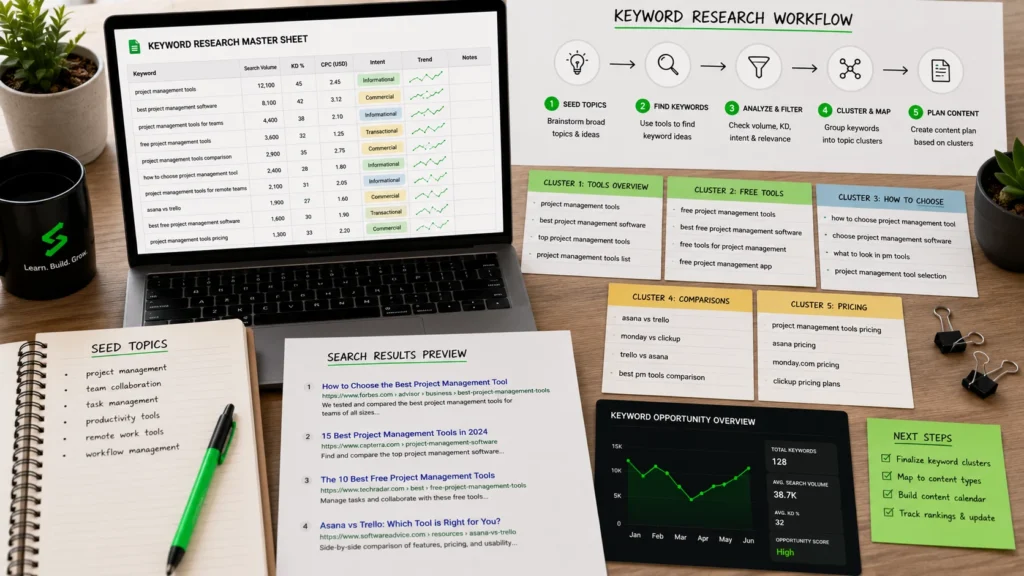
This beginner workflow is effective keyword research for blogging because it starts with the SERP, not the spreadsheet. Current SEO advice increasingly recommends reading the search results before deciding what to write, because the search page shows you the intent, depth, and content style Google already prefers. That makes it easier to choose a keyword you can realistically compete for and turn it into a post with a better chance of ranking.
How Do You Turn Keywords Into Topics?
After choosing the keyword, turn it into a topic that sounds useful to a human. A keyword is not the final article title; it is the starting point.
For example:
- Keyword: keyword research for blogging.
- Topic: How beginners can find blog topics that rank.
- Angle: intent, difficulty, and content fit.
- Format: step-by-step guide.
This keeps your article readable and helps it perform better for Discover and AI Overviews. Google’s helpful content guidance favors useful, people-first content that fully satisfies the query.
How-To Section
Times Needed : 1 Days, 4 Hours, 30 Minutes
Estimated Cost : USD 0
Description : Learn a simple beginner workflow for finding blog keywords that match intent, fit your niche, and have a realistic chance to rank.
Tools Name : Google Search, keyword planner, spreadsheet
Materials Name : Seed topics, competitor examples, content idea list
Steps:
- List your seed topics : Write down 5–10 broad topics you already want to cover for keyword research for blogging, based on your niche and audience needs.
- Check search intent : Search each topic in Google and note whether readers want a guide, comparison, or answer.
- Review difficulty : Keep keywords that feel realistic for your current blog size and authority.
- Group related ideas : Cluster similar keywords together so each article has one clear purpose.
- Pick the best topic : Choose the keyword that balances intent, fit, and a realistic ranking opportunity for keyword research for blogging.
How Do You Use Long-Tail Keywords?
Long-tail keywords are more specific phrases, and they are often easier to rank for. They are especially useful for new bloggers because they attract readers with clearer intent and usually match a very specific problem or question. That makes it easier to write content that feels useful, focused, and relevant from the first paragraph.
Examples:
- How to do keyword research for blogging.
- Keyword research tools for beginners.
- Low competition blog keywords.
- How to find blog topics that rank.
Ahrefs and other keyword strategy resources often recommend using long-tail terms early because they are more targeted and easier to align with content. That makes them ideal for a blog that is still building authority. As your site grows, these smaller wins can also help you build topical depth, improve trust, and create a stronger foundation for broader keywords later.
Why Should You Avoid Chasing Volume?
Chasing volume alone can lead you to the wrong topics in keyword research for blogging. A huge keyword may look attractive, but if the search intent is wrong or the competition is too strong, the article may never perform. In many cases, that means you end up writing content that gets impressions but not real engagement or traffic quality.
It is usually better to win smaller, more relevant keywords first in keyword research for blogging. That builds trust, traffic, and topical depth over time. Once your site grows, you can target broader terms with more confidence. Those smaller wins also help search engines understand your niche better, which can make later ranking efforts more effective.
“A good keyword is one you can win, one your user is searching for, and one that fits your business.” — keyword evaluation principle supported by SEO guidance
What Tools Can Help Most?
You do not need expensive software to start. A few tools are enough for a beginner keyword research for blogging workflow, and the most important part is learning how to use them consistently.
- Google Search : to study intent and competitors.
- Keyword Planner : to find related terms.
- Spreadsheet : to track ideas and decisions.
- Search Console : to revisit what already performs.
Keyword research for blogging tools help you move from guessing to a repeatable system. Blogging Wizard, Ahrefs, and Kinsta all emphasize starting simple and building a process you can repeat. As you get more comfortable, you can add better filters, compare opportunities more carefully, and create a keyword system that scales over time.
FAQ
What is keyword research for blogging?
It is the process of finding search terms your audience uses and choosing the ones that best fit your blog.
Should beginners target high-volume keywords?
Not first. Beginners usually do better with lower-competition keywords that match their content and current authority.
What is the best keyword type for new blogs?
Long-tail, intent-based keywords usually work best because they are more specific and easier to rank for.
How many keywords should I target in one post?
Use one primary keyword and a few closely related variations. Do not force too many unrelated terms into one post.
How do I know if a keyword has good intent?
Search it on Google and look at the top results. If they match the content format you want to create, the intent is likely a fit.
What makes a keyword worth writing about?
A keyword is worth writing about when it matches search intent, fits your niche, and gives you a realistic chance to rank.
Do I need paid tools to do keyword research?
No. Beginners can start with free search results, Google tools, and a spreadsheet.
How often should I update keyword research?
Review it regularly as your blog grows, because your content opportunities and competition will change over time.
Key Takeaways
- Keyword research for blogging works best when you prioritize intent, difficulty, and content fit.
- Long-tail keywords are ideal for new bloggers because they are more specific and realistic to target.
- You should study Google’s results before choosing a topic.
- A simple spreadsheet system is enough to start.
- Winning smaller, relevant keywords first builds stronger long-term SEO momentum.
Next Steps
Start with 10 seed topics, search each one, and choose the best five based on keyword research for blogging, intent and fit. Then turn each chosen keyword into one clear blog post and connect it to your content plan.
If you want a deeper training path, the AI-Powered Content SEO Premium Internship Program by StartupAcademy can help you learn keyword planning in a practical workflow. For broader growth skills, the AI-Powered Digital Marketing Internship Program by StartupAcademy is also relevant.
Conclusion
The smartest way to approach keyword research for blogging is to stop chasing the biggest numbers and start choosing better topics. When you focus on intent, difficulty, and content fit, you create content that has a much better chance to rank and attract the right readers.
Use the same repeatable process each time, and your blog will grow with more clarity and less guesswork. Downloading a keyword checklist is a good next move, because it keeps your research organized and easy to repeat.
Resources
- Keyword Research: The Complete Beginner’s Guide — Useful for beginner keyword workflows.
- How to Do Keyword Research for SEO — Good for research structure and clustering.
- What Is Keyword Intent? — Helps you understand searcher goals.
- A Step-by-Step Guide to Keyword Research — Strong for prioritization and low-hanging fruit.
- How to Choose the Right Keywords — Helpful for relevance, volume, and difficulty.