Our Jun2Aug Internship Batches are open. Join Now!
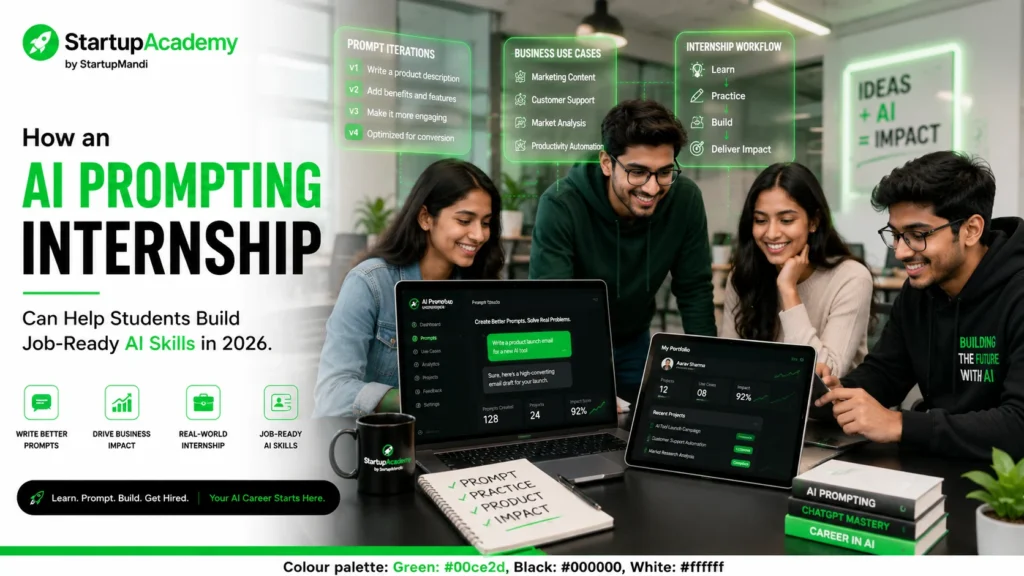
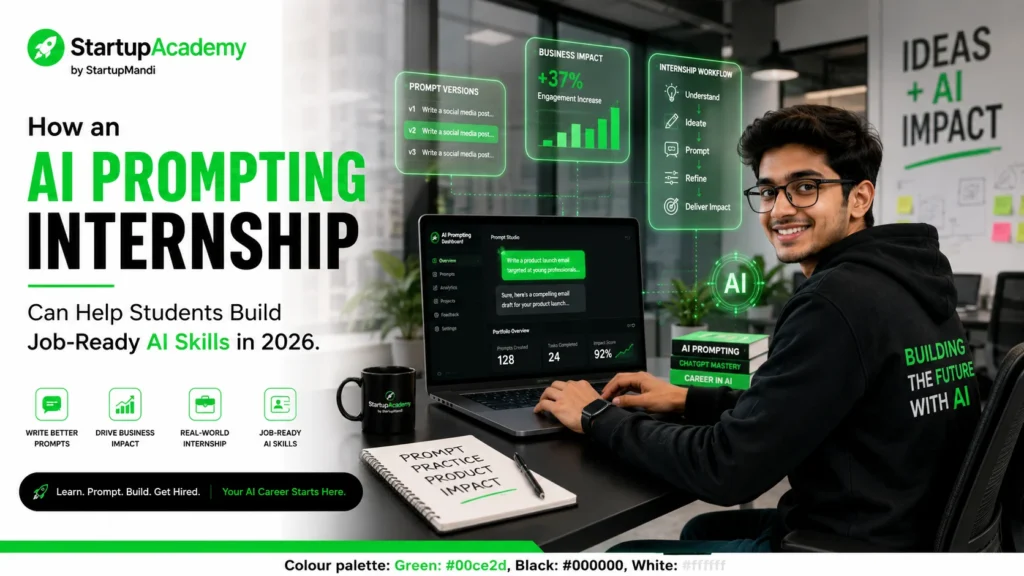
An AI Prompting Internship is one of the fastest ways for students to turn AI theory into practical, job-ready skills in 2026. It helps you learn how to write, test, improve, and apply prompts for real business tasks while building a portfolio that employers can actually review.
Quick Summary
An AI prompting internship teaches students how to use generative AI in real workflows, not just in classroom demos. It builds practical skills in prompt design, AI communication, business problem-solving, and portfolio creation, which are increasingly important as employers expect more AI fluency and adaptability. It also helps freshers, career changers, and AI enthusiasts show proof of work through live projects, case studies, and measurable outcomes.
Table of Contents
What Is an AI Prompting Internship?
An AI prompting internship is a structured learning role where you practice creating prompts for AI tools and solving business problems with them. Instead of only studying AI concepts, you work on tasks like content generation, customer support automation, research summarization, data structuring, and workflow optimization.
This makes it valuable for beginners because it connects classroom learning to real use cases. It also matters in 2026 because employers increasingly want people who can use AI responsibly, communicate clearly with AI systems, and improve output quality through iteration.
Why Does It Matter in 2026?
AI skills are no longer optional for many entry-level roles. The World Economic Forum says employers expect 39% of key skills in the job market to change by 2030, and AI and big data are among the top growing skill areas.
UNESCO also highlights the need for human-centered AI readiness and proper guidance for education and research.
That shift means students need more than theory. They need hands-on proof that they can use AI tools to save time, improve quality, and support business outcomes. A prompt engineering internship gives exactly that kind of proof through measurable work samples.
“Prompt engineering becomes most powerful when applied to real business problems.” — Udacity
How Does It Bridge Theory and Practice?
An AI Prompting Internship bridges the gap by turning abstract concepts into repeatable business tasks. You might start with simple prompt writing, then move to prompt testing, output evaluation, and workflow design for real teams.
Here is why that matters:
- You learn how AI tools behave across different instructions and constraints.
- You understand how businesses use AI for efficiency, accuracy, and speed.
- You build reusable prompt templates that solve practical problems.
- You create portfolio projects that show employers your process, not just your final result.
This is the difference between knowing AI and being useful with AI.
What Skills Do You Learn?
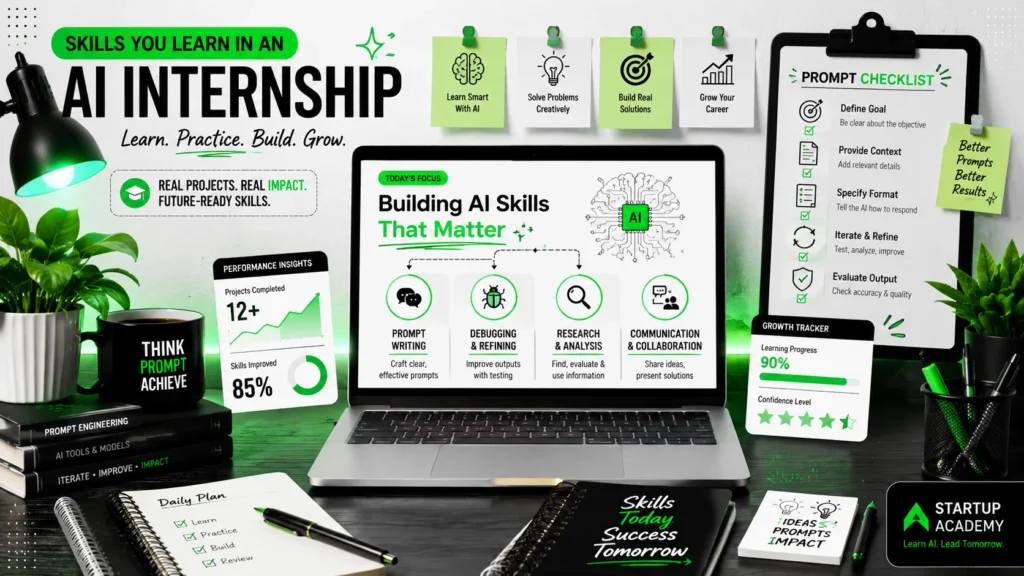
A good internship should teach both technical and workplace skills. Coursera’s AI internship guidance and skills resources point to skills like prompt literacy, critical thinking, privacy awareness, iterative problem-solving, and understanding AI limitations.
Core skills
- Prompt writing and refinement.
- AI output evaluation and debugging.
- Business communication and task breakdown.
- Research summarization and structured reporting.
- Responsible AI use and data privacy awareness.
Workplace skills
- Time management.
- Collaboration with mentors and teams.
- Clear documentation.
- Presentation of results.
- Portfolio storytelling.
These skills are useful across internships, freelance work, and entry-level roles, especially in content, operations, marketing, customer support, and product teams.
Which Business Use Cases Matter?
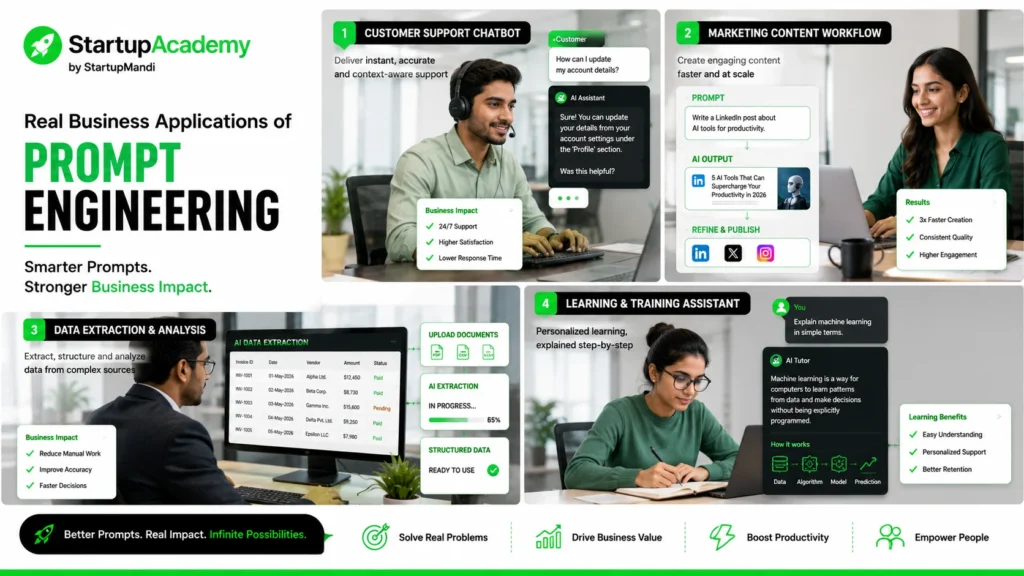
Prompt engineering works best when tied to business outcomes. Real-world case studies show use cases across customer support, marketing, data extraction, documentation, education, and compliance-heavy workflows.
This is where students see the biggest shift. They stop asking, “What is AI?” and start asking, “How can AI help this business task?” That mindset is what hiring managers notice.
What Makes It Job-Ready?
Job readiness means you can do useful work with limited supervision. An AI prompting internship builds that by giving you repeatable workflows, feedback loops, and practical deliverables.
Here are the strongest job-ready outcomes:
- You can create prompt templates for specific outcomes.
- You can compare outputs and choose the best one.
- You can document your process clearly.
- You can present a mini case study in interviews.
- You can show a portfolio with real examples.
Portfolio proof example
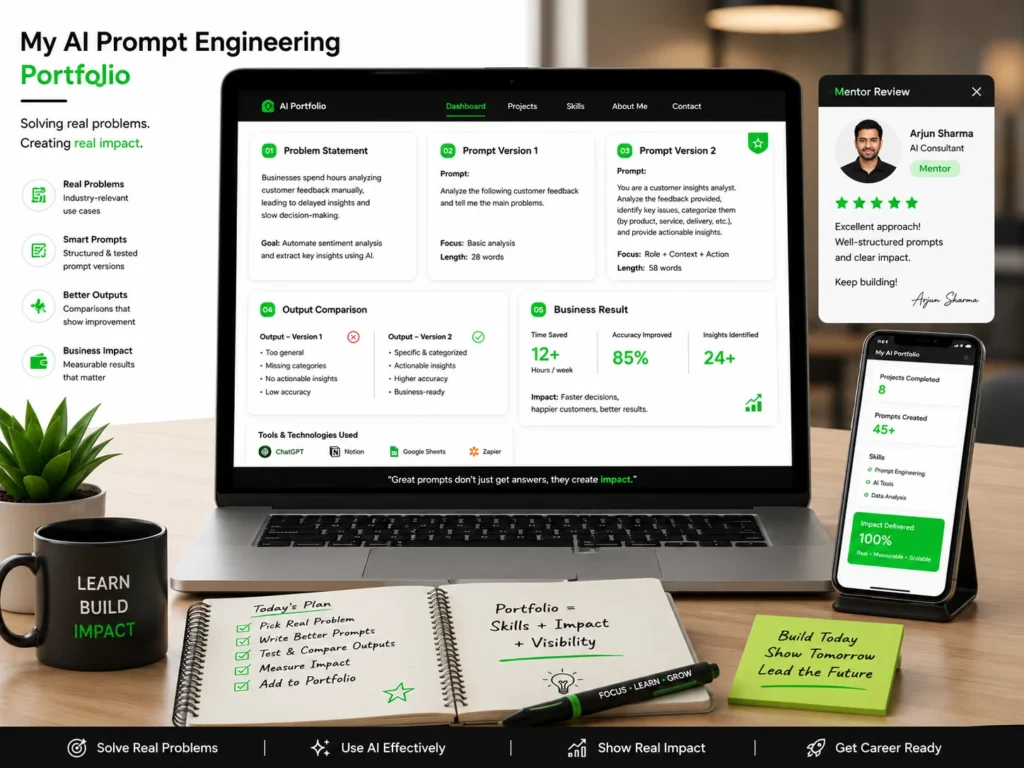
A student can create a prompt portfolio with:
- A customer support automation prompt.
- A marketing copy prompt.
- A research summarization workflow.
- A before-and-after prompt improvement log.
- A short case study with results.
That is much stronger than saying “I used ChatGPT.”
What Do Employers Look For?
Hiring teams usually care about clarity, accountability, and business thinking. They want to see whether you can use AI to improve productivity without losing accuracy or ethics. They also value candidates who can learn quickly, adapt to new tools, and communicate outcomes in simple language.
Employer checklist
- Can you explain your prompt choices?
- Can you handle vague business requests?
- Can you measure improvement?
- Can you follow privacy and quality rules?
- Can you present your work professionally?
If you can answer yes to most of these, you already look stronger than many entry-level applicants.
How Should Students Start?
Start with a beginner-friendly internship that offers live projects, mentor feedback, and portfolio-building tasks. AICTE’s internship portal and public listings show that prompt engineering and generative AI internships are already appearing in India, including remote and paid opportunities.
Simple start plan:
- Learn the basics of prompt engineering.
- Practice with one AI tool consistently.
- Build 3 small use-case projects.
- Document your prompt changes and results.
- Apply to internships that mention live work, not just certificates.
How To Do This?
Times Needed: 14 Days, 20 Hours, 00 Minutes
Estimated Cost: USD 0
Description: A beginner plan to become internship-ready by learning prompt basics, building portfolio samples, and practicing real business use cases.
Steps:
- Learn prompt basics: Study how instructions, context, constraints, and examples change AI output quality. Focus on writing prompts that solve a real task, not just generating text.
- Practice one business use case: Pick one area such as support, marketing, or research. Create 5 prompts and improve them until the output becomes consistent and useful.
- Build a mini portfolio: Save your best prompts, outputs, and short reflections in a document or website. Add a one-line result for each project to show practical value.
- Apply and present clearly: Use your portfolio in internship applications and interviews. Explain what changed, why it changed, and how it improved the result.
Tools Name: ChatGPT, Google Docs, Notion, Canva
Materials Name: Laptop, internet connection, sample business brief, portfolio template
What Does a Good Internship Look Like?
A strong internship should include real tasks, structured feedback, and a final deliverable. It should not feel like passive observation. The best programs let students work on prompt testing, use-case design, content workflows, or AI-assisted research while learning from mentors.
Good signs to look for
- Live projects.
- Clear learning outcomes.
- Mentor feedback.
- Internship certificate.
- Portfolio or case-study output.
StartupAcademy by StartupMandi AI can position this well by offering beginner-friendly, practical learning paths that help students move from curiosity to competence. That makes it easier to talk about skills, not just attendance.
How Can Students Build a Portfolio?
A portfolio should show your thinking process. Employers want to know how you solved a problem, how you improved the prompt, and what business value it created.
Here’s a simple structure:
- Problem statement.
- Prompt version 1.
- Prompt version 2.
- Improved output.
- Outcome or lesson learned.
You can publish it as a PDF, a Notion page, or a personal site. Even three polished examples can make your profile look far more credible.
“Real-world use cases unlock the value of prompt engineering.” — Udacity
Key Takeaways
- An AI Prompting Internship helps students turn AI theory into practical work.
- It builds prompt literacy, problem-solving, and portfolio-ready proof of skill.
- Employers value AI fluency, adaptability, and responsible use.
- Real-world projects matter more than certificates alone.
- Beginners should focus on one use case, one tool, and one portfolio.
Next Steps
- Start with a free AI tool and practice daily.
- Build three use-case projects for your portfolio.
- Apply for internships with live projects and mentor support.
- Add your work to LinkedIn and a simple portfolio page.
- Comment and DM StartupAcademy by StartupMandi AI to learn more.
FAQs to Know
1. What is an AI Prompting Internship?
It is an internship where students learn to write, test, and improve prompts for AI tools in real business scenarios.
2. Is prompt engineering good for beginners?
Yes. It is beginner-friendly because it teaches practical AI use without requiring advanced coding first.
3. Do I need coding knowledge for this internship?
Not always. Many internships focus on AI content, workflow design, and prompt testing rather than heavy programming.
4. What can I put in my portfolio?
Add prompt examples, before-and-after improvements, use-case notes, and short case studies with outcomes.
5. Why do companies want prompt skills?
Because prompts can improve speed, quality, and consistency in tasks like support, content, data work, and documentation.
6. Can freshers apply for these internships?
Yes. Many listings target students, freshers, and remote learners interested in generative AI and prompt engineering.
7. How long should I learn before applying?
Two weeks of focused practice can be enough to build a small portfolio and apply confidently.
8. Is prompt engineering still relevant in 2026?
Yes. AI adoption is rising, and employers continue to value practical AI use, problem-solving, and adaptability.
Resources
- UNESCO guidance on generative AI in education for ethical and learner-centered AI use.
- World Economic Forum Future of Jobs 2025 for skills trends and labor-market changes.
- Coursera AI internship overview for internship-oriented learning paths.
- Udacity prompt engineering guide for use cases and practical applications.
- CodeSignal prompt engineering portfolio guide for portfolio-building ideas.
Conclusion
An AI Prompting Internship is one of the smartest ways for students to become job-ready in 2026 because it combines AI practice, business relevance, and portfolio proof. It helps you move beyond theory and show employers that you can solve real problems with AI.
For more career-focused learning, explore StartupAcademy by StartupMandi AI and its beginner-friendly skill paths through the internal links:
- AI-Powered Content & SEO – Premium Internship Program (3 Months)
- AI-Powered Digital Marketing – Premium Internship Program (3 Months)
Comment and DM to start building your AI portfolio with confidence.
Few Links Suggestions for More Research & Facts Check