Our Jun2Aug Internship Batches are open. Join Now!


An internship on search engine optimization for freshers is one of the best ways to learn how websites grow through Google Search. It helps you build practical skills in keyword research, content optimization, on-page SEO, and reporting while you work on real tasks.
Table of Contents
What Is an SEO Internship?
An SEO internship is a beginner-friendly training role where you learn how to improve a website’s visibility on search engines. In simple terms, you help pages rank better by making them more useful, clearer, and easier for Google to understand.
For freshers, this usually means working on:
- Keyword research.
- Writing or improving blog content.
- Optimizing titles, meta descriptions, and headings.
- Basic competitor analysis.
- Using tools like Google Search Console and Google Analytics.
Actionable takeaway: If you are new to digital marketing, start by learning how search engines read content and how users search for information. Google recommends thinking about the words readers actually use, not just industry jargon.

Why Freshers Should Choose SEO
SEO is a strong starting point because it teaches both strategy and execution. You do not need to be a coder to begin, but you do need curiosity, writing clarity, and consistency.
For freshers, SEO offers three major advantages:
- You learn a skill that businesses actively need.
- You build a portfolio through real content and optimization work.
- You gain exposure to digital marketing, content strategy, and analytics.
SEO is also a useful entry point if you want to move into content marketing, performance marketing, or growth roles later. Search-intent focused content is now important not only for Google rankings but also for AI-driven search experiences, which reward clear, scannable, answer-first writing.
Actionable takeaway: Treat your first SEO internship as a foundation for multiple career paths, not just a single job.
Skills You Need to Start
You do not need advanced experience to apply for an internship on search engine optimization for freshers. However, a few core skills will help you get shortlisted and perform better.
Core SEO skills
- Keyword research.
- Understanding search intent.
- On-page SEO.
- Internal linking.
- Basic technical SEO.
- Content optimization for blogs and landing pages.
Helpful tools
- Google Search Console.
- Google Analytics.
- Google Keyword Planner.
- Ahrefs, Semrush, or Ubersuggest.
- WordPress basics.
Soft skills
- Clear writing.
- Attention to detail.
- Research mindset.
- Time management.
- Willingness to learn.
A strong SEO intern also knows how to write content that answers user questions directly. That matters because search engines and AI overviews increasingly favor pages that are easy to scan and genuinely helpful.
Actionable takeaway: Learn one keyword tool and one reporting tool before you apply.
What You Learn During the Internship
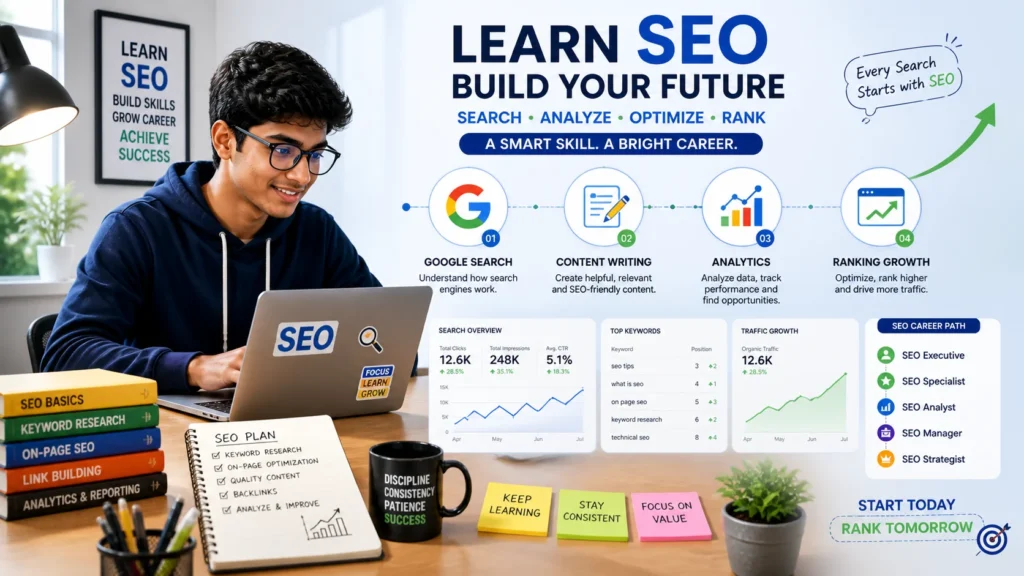
A good SEO internship should give you structured exposure to both content and optimization work. Here is what a fresher can realistically expect to learn.
Week-to-week learning areas
- Finding keywords with search volume and intent.
- Writing SEO-friendly blog outlines.
- Improving titles, headers, and meta descriptions.
- Adding internal links to relevant pages.
- Understanding ranking signals and content quality.
- Tracking impressions, clicks, and page performance.
Example workflow
- Research a keyword.
- Check what users want from that keyword.
- Write or improve the content.
- Optimize headings and metadata.
- Add internal links.
- Review performance in Search Console.
This workflow matches Google’s guidance on writing for readers and making content easy to understand. It also reflects modern internal linking best practices, where links should be relevant, descriptive, and placed naturally within the content.
Actionable takeaway: Practice this workflow on one blog post every week to build confidence quickly.
Common Pain Points Freshers Face
Many beginners want to enter SEO but feel unsure about where to start. That is normal, especially if you come from a non-marketing background.
Common challenges
- Not knowing SEO terminology.
- Confusing keyword stuffing with real optimization.
- Writing content that is too broad or too vague.
- Failing to understand search intent.
- Not having portfolio samples.
- Lack of guidance on tools and reporting.
The best way to overcome these issues is to learn SEO through hands-on work, not just theory. Search intent is especially important because the same keyword can require different formats, such as a guide, a checklist, or a comparison page.
Actionable takeaway: Focus on solving one SEO problem at a time instead of trying to learn everything at once.
How to Choose the Right Internship
Not all internships are equally useful. Some offer only basic observation, while others give you real work, feedback, and portfolio-building opportunities.
Look for these features
- Live project exposure.
- Mentorship or review support.
- Content and SEO training modules.
- Tool-based learning.
- Clear internship outcomes.
- Certificate and portfolio support.
If your goal is career readiness, choose a program that teaches both SEO concepts and execution. A structured internship should help you understand how to write for search intent, use internal links effectively, and create content that can perform in AI-assisted search environments.
Actionable takeaway: Before enrolling, ask whether the internship includes practical assignments and mentor feedback.
Why StartupAcademy Premium Programs Stand Out
StartupAcademy’s premium internship programs are designed for learners who want more than passive training. They combine practical learning with job-oriented exposure, making them suitable for freshers who want to build real SEO and digital marketing capability.
You can explore:
These programs are a strong fit if you want to learn content optimization, SEO workflows, and digital marketing fundamentals in one place. They are also useful for learners who want a practical path from beginner to internship-ready profile.
Actionable takeaway: Choose a program that gives you both SEO training and project practice so your resume shows evidence, not just attendance.
SEO Basics Every Fresher Should Know
Before applying, make sure you understand these essentials.
On-page SEO
This includes optimizing the content itself, such as titles, headings, keyword placement, and meta descriptions.
Off-page SEO
This involves signals outside the page, such as backlinks and brand mentions.
Technical SEO
This covers crawling, indexing, page speed, and site structure.
Content SEO
This means writing useful content that matches user intent and can rank for relevant queries.
Google’s documentation highlights the importance of clear descriptions, reader-focused content, and anticipating search terms. Internal links also help users navigate and help search engines understand your site structure.
Actionable takeaway: Learn the difference between on-page, off-page, technical, and content SEO before your first interview.
Tips to Build a Strong Fresher Profile
A fresher with no job experience can still look strong if the profile shows learning and initiative.
What to add to your resume
- SEO coursework.
- Blog samples.
- Keyword research examples.
- Internship projects.
- Tools you have used.
- A short summary of your interest in digital marketing.
What to include in a portfolio
- Before-and-after content samples.
- Keyword maps.
- Meta title and description examples.
- Search Console screenshots with learnings.
- Short case studies on any optimization work.
A portfolio helps because SEO is a practical field. Recruiters often want to see how you think, not just what you studied.
Actionable takeaway: Create one simple SEO portfolio page with 3 sample projects before applying.
Conclusion
An internship on search engine optimization for freshers is a smart way to build a real digital marketing career. It teaches practical SEO skills, strengthens your resume, and gives you exposure to the kind of work companies actually need.
If you want to move beyond theory, a structured premium internship can help you learn faster and create proof of work. That is especially useful when you are starting out and want a guided path into SEO and digital marketing.
Actionable takeaway: Start with one SEO internship, one portfolio, and one consistent learning routine.
FAQ Section:
What is an internship on search engine optimization for freshers?
It is a beginner-friendly training opportunity where you learn SEO basics like keyword research, content optimization, on-page SEO, and reporting while working on real tasks.
Do freshers need coding knowledge for SEO internships?
No, coding is not required for most beginner SEO internships. Basic website and WordPress understanding helps, but writing, research, and analysis matter more.
What tools should a fresher learn for SEO?
Start with Google Search Console, Google Analytics, Google Keyword Planner, and one SEO tool like Ahrefs, Semrush, or Ubersuggest.
How long does it take to learn SEO basics?
A fresher can learn the basics in a few weeks with regular practice, but becoming comfortable with real projects usually takes longer and improves through hands-on work.
Is SEO a good career for students and recent graduates?
Yes. SEO is a practical entry point into digital marketing and can lead to roles in content, analytics, growth, and marketing strategy.
How can I make my resume better for an SEO internship?
Add samples of keyword research, blog optimization, content samples, and any SEO projects you have completed during training or self-learning.
Why does search intent matter in SEO?
Search intent tells you what the user really wants. Matching intent helps content perform better because it becomes more useful and relevant.
Suggested External References:
- Google Search Central SEO Starter Guide
- Google Search Central Meta Descriptions
- Google Search Central AI Search Guidance
- Moz Internal Linking Guide
CTA Block:
Want practical SEO training with real project exposure? Explore StartupAcademy’s premium internship paths and choose the one that fits your career goal:
These programs are a strong next step for freshers who want structured learning, portfolio-building support, and a clearer route into digital marketing careers.