Our Jun2Aug Internship Batches are open. Join Now!

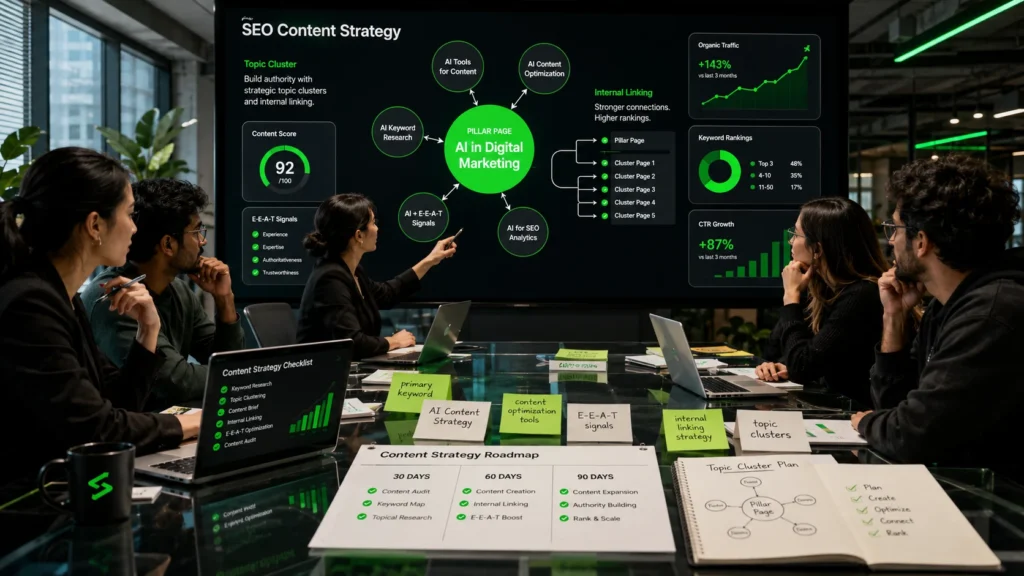
Table of Contents
An effective SEO content strategy helps you choose the right topics, match search intent, and connect each post to business goals. In this guide, you’ll learn how to build a repeatable system that improves rankings, supports discoverability, and drives conversions. Google recommends people-first content, crawlable links, and descriptive page elements, so the structure matters as much as the writing.
Quick summary: Start with one core topic, break it into clusters, map each keyword to intent, and publish in a linked content system. That approach aligns with Google’s guidance on helpful content and topical organization.
What Is SEO content strategy?
SEO content strategy is the process of planning, organizing, and publishing content that matches search demand, user intent, and business goals. A strong SEO content strategy is not just about writing blog posts for Google. It is a repeatable system for deciding what to publish, how posts connect through internal links, and how each page supports visibility and conversions.
When you build a solid SEO content strategy, you define:
- A core topic that supports multiple subtopics.
- A set of keyword clusters tied to intent.
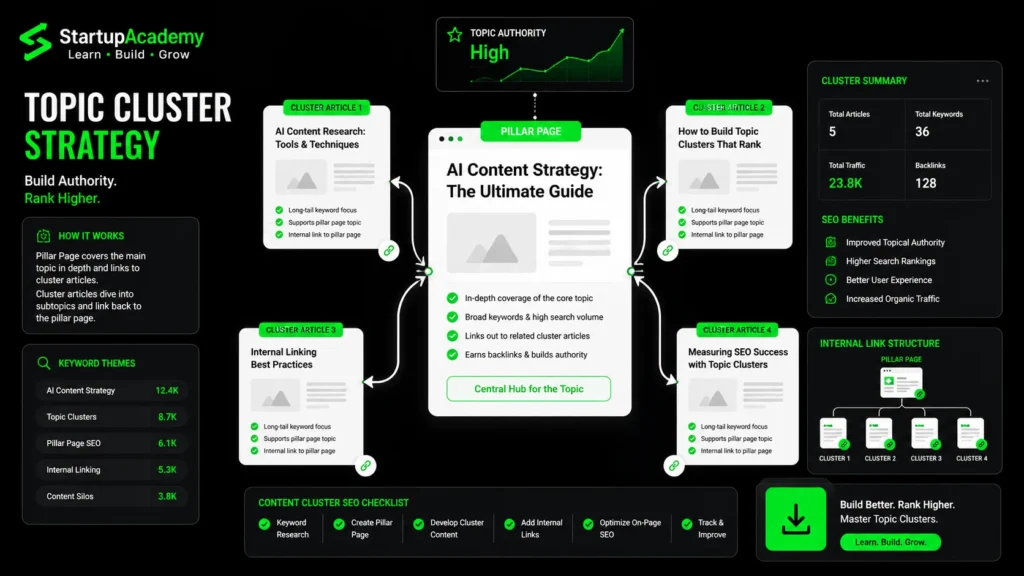
- A structure with pillar pages and cluster posts.
- Internal linking patterns that strengthen topical authority.
HubSpot and Semrush both describe an SEO content strategy as a structured way to organize topics, long-tail keywords, and interlinked pages so your site looks authoritative to search engines. That structure helps readers navigate and helps search engines understand your topics clearly. Without an SEO content strategy, your blog often becomes a collection of random posts with weak rankings.
“The best content strategy is not random publishing. It is organized expertise, delivered in the order searchers need it.” — StartupAcademy editorial principle
Why does topical structure matter?
Topical structure matters because search engines reward clarity, depth, and relevance. When related articles link to a main pillar page, you signal that your site covers the topic comprehensively. Semrush and SEOClarity both describe topic clusters as interconnected content grouped around a central theme.
This also improves user experience. Readers can move from a broad guide to specific subtopics without leaving your site, which supports engagement and trust. Google’s Search Essentials explicitly recommends descriptive link text and crawlable links so search engines can discover more pages on your site.
How do you choose a core topic?
Choose a core topic that is broad enough to support several articles but specific enough to fit your niche. For StartupAcademy by StartupMandi AI, the core topic should connect naturally to digital growth, content marketing, and practical SEO.
A good core topic usually has three qualities:
- Clear business relevance.
- Multiple useful subtopics.
- Strong search demand with realistic competition.
HubSpot’s content strategy guidance recommends choosing main topics that represent your expertise and then building subtopic keywords around them. That makes your blog easier to scale and easier to rank.
How do keyword clusters work?
Keyword clusters group related queries under one topic umbrella. Instead of targeting one keyword per post in isolation, you build a family of pages that answer related questions. Semrush recommends using primary terms and secondary terms together to support the main page.
Here is a simple cluster model for this topic:
| Page Type | Target Query | Purpose |
|---|---|---|
| Pillar page | SEO content strategy | Main authority page |
| Cluster post | content planning framework | Supporting guide |
| Cluster post | topical clusters | Supporting explainer |
| Cluster post | internal linking strategy | Supporting optimization post |
| Cluster post | blog SEO checklist | Supporting action post |
This model helps you capture more search variations while keeping your site organized. It also creates more opportunities for internal links, which Google says should be crawlable and descriptive.
How do you match search intent?
Search intent is the reason behind a search—what the user really wants when typing a query. Someone searching “SEO content strategy” wants a strategic framework, not a product pitch. They want to learn how to plan, organize, and execute content that ranks and converts.
Semrush and other SEO guidance stress that your content must match:
- What is already ranking for that query.
- What the reader expects based on similar results.
If most top results are long guides with frameworks and steps, your post should do the same. Matching ranking patterns and reader expectations helps your content feel relevant to users and search engines.
How Do You Map Search Intent for Your Topic?
Use this intent map:
- Informational intent
The user wants to learn the concept.
Example: “What is SEO content strategy?”
Goal: Explain the topic with definitions and examples. - Strategy intent
The user wants to build a system.
Example: “SEO content strategy framework”
Goal: Show how to structure topics, clusters, and internal links. - How-to intent
The user wants to apply the process.
Example: “How to build an SEO content strategy”
Goal: Provide step-by-step instructions with tools and workflows. - Comparison intent
The user wants to evaluate methods.
Example: “SEO content strategy vs traditional content plan”
Goal: Compare approaches, pros, cons, and use cases. - Transactional intent
The user wants to buy or sign up.
Example: “SEO content strategy course”
Goal: Present offers, programs, or services clearly.
For your blog, the primary intent is strategy intent, with supporting how-to elements. Readers want both a framework and actionable steps.
Why Does Matching Intent Improve Rankings?
When your content matches search intent:
- Readers stay longer and engage more.
- Google sees your page as a better answer.
- You reduce bounce rates and improve satisfaction.
- Your content becomes more likely to be cited in AI Overviews.
A good strategy post should:
- Teach the concept clearly.
- Organize information into a logical system.
- Guide action with steps and next actions.
Headings should:
- Answer questions directly.
- Use question-based H2s like “How Do You Build an SEO Content Strategy?”
- Avoid vague titles.
Examples should be:
- Practical and real-world.
- Related to your audience.
- Tied to immediate actions.
Google’s helpful content guidance emphasizes:
- People-first usefulness over search-engine tricks.
- Original analysis and unique insights.
- Substantial value that answers the query fully.
When you write an SEO content strategy post that teaches, organizes, and guides action, you align with user intent and Google’s expectations. This alignment is core to a strong content strategy and helps your content rank better, get discovered, and be cited by AI tools.
How should you build the outline?
Build the outline from the search journey, not from your opinions. Start with the main question, then add sections that answer supporting questions in the order readers naturally ask them. That approach improves readability and increases your chance of being extracted into AI Overviews.
Use this outline pattern:
- Define the topic.
- Explain why it matters.
- Show the planning framework.
- Give a repeatable workflow.
- Add tools, examples, and next steps.
Keep headings short and question-based so they work well for snippets and AI extraction. Semrush recommends clear subheadings, short paragraphs, and list formatting to make long content easier to scan.
What does a planning workflow look like?
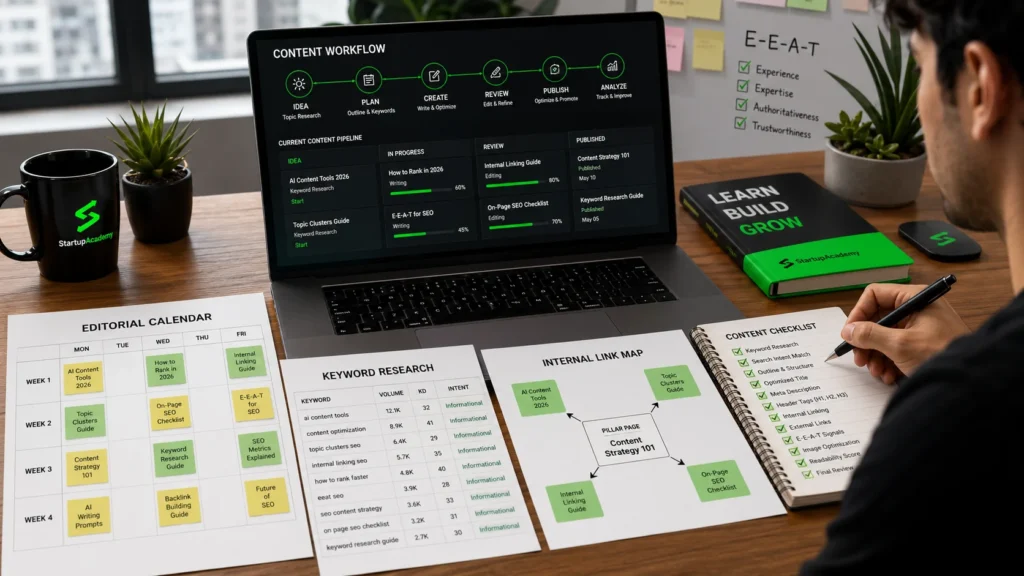
A repeatable workflow turns strategy into output. Below is a simple process StartupAcademy can use for every blog series.
| Step | Action | Output |
|---|---|---|
| 1 | Pick a pillar topic | Main content theme |
| 2 | Research search terms | Keyword list |
| 3 | Map intent | Content angle |
| 4 | Draft cluster posts | Supporting articles |
| 5 | Add internal links | Topic connection |
| 6 | Optimize metadata | Better CTR |
| 7 | Review performance | Next content decisions |
This workflow mirrors the planning logic described by HubSpot and other SEO strategy resources, where topic selection, cluster mapping, and publishing cadence all work together. The result is a scalable editorial system, not a one-off article.
How do internal links improve results?
Internal links help distribute authority, guide readers, and help crawlers find more pages. Google Search Essentials recommends crawlable links and descriptive anchor text because they improve discoverability. Semrush also highlights internal linking as a core part of topic cluster SEO.
For this blog, use these internal links naturally:
- AI-Powered Content SEO Premium Internship Program for readers who want hands-on SEO content training.
- AI-Powered Digital Marketing Internship Program for readers who want broader growth skills.
Use anchor text that explains why the link matters. For example, “Learn practical SEO content workflows” is stronger than a generic “Read more.”
What statistics support this approach?
Search-focused structure is not just theory. Google says helpful, reliable, people-first content should be created for users first, with relevant words placed in prominent locations such as titles, headings, alt text, and link text. Semrush also notes that blog SEO now has to work for both Google and AI tools, which raises the value of clear structure and concise answers.
A useful industry benchmark from HubSpot’s guidance is that pillar content often needs substantial depth to function as a strong hub, and their content strategy workflow uses pillar pages plus subtopics to organize expertise. That supports the practical recommendation to build a central guide around a topic instead of scattering related posts randomly.
Which tools help most?
You do not need a large stack to execute this well. A few focused tools are enough for research, writing, and tracking.
- Keyword research tools, for identifying demand and related terms.
- Google Search Console, for measuring impressions and clicks.
- A content brief template, for keeping posts consistent.
- An internal linking checklist, for maintaining topic connections.
HubSpot and Semrush both frame content strategy as a research-to-publish workflow, which is why planning tools matter as much as writing tools.
“Content that ranks is usually content that is easier to understand, easier to navigate, and easier to trust.” — StartupAcademy editorial standard
How do you optimize for Discover and AI Overviews?
To improve Google Discover visibility, you need strong imagery, fresh angles, and reader-first framing. Discover tends to reward interesting, timely, and visually engaging content, so your headline and featured image matter. For SEO content strategy, this means your meta title and image should hint at value without feeling clicky.
To improve AI Overview eligibility, make answers direct, concise, and well-structured with question headings and list formatting. This is especially important when writing an SEO content strategy guide, because AI systems look for clear, structured answers that can be extracted quickly.
Use these techniques to support both Google Discover and AI Overview performance:
- Put the direct answer in the first paragraph.
- Use question-based H2s that match search queries.
- Add structured tables for comparisons and steps.
- Include short definitions of key terms like pillar page or cluster.
- Use descriptive anchor text for internal links.
This approach makes your SEO content strategy article easier to parse for both readers and search systems. It also supports featured snippets and voice search variations, which are increasingly relevant as SEO content strategy evolves beyond traditional Google rankings.
When you build an SEO content strategy with these principles, your content becomes more discoverable not only in search results but also in AI-generated summaries and visual feeds like Discover.
How-To Section
Times Needed: 2 Days, 6 Hours, 30 Minutes
Estimated Cost: USD 0
Description: Build a repeatable SEO content workflow that turns one core topic into a ranking blog system with measurable structure and internal links.
Tools Name: Google Search Console, keyword research tool, content brief template
Materials Name: Topic map, publishing calendar, internal linking checklist
Steps:
- Pick one pillar topic. Choose a broad topic your audience searches for often, and make sure it can support multiple related articles.
- Collect supporting keywords. Find long-tail terms, intent-based questions, and related phrases that fit the pillar topic naturally.
- Map each keyword to intent. Decide whether the post should inform, compare, teach, or convert before writing the outline.
- Write one linked cluster. Publish the pillar page and supporting posts together, then connect them with descriptive internal links.
- Optimize before publishing. Check title, headings, meta description, image alt text, and anchor text for clarity and relevance.
What should the content calendar include?
A content calendar should tell you what to publish, why it matters, and how each post supports the next one. It should also prevent topic overlap and random publishing. HubSpot’s strategy approach emphasizes consistent scheduling and building around core topics.
A useful calendar includes:
- Core topic.
- Search intent.
- Primary keyword.
- Supporting posts.
- Internal links.
- CTA destination.
This format keeps your editorial plan connected to business goals. It also makes it easier to reuse successful structures later.
FAQ
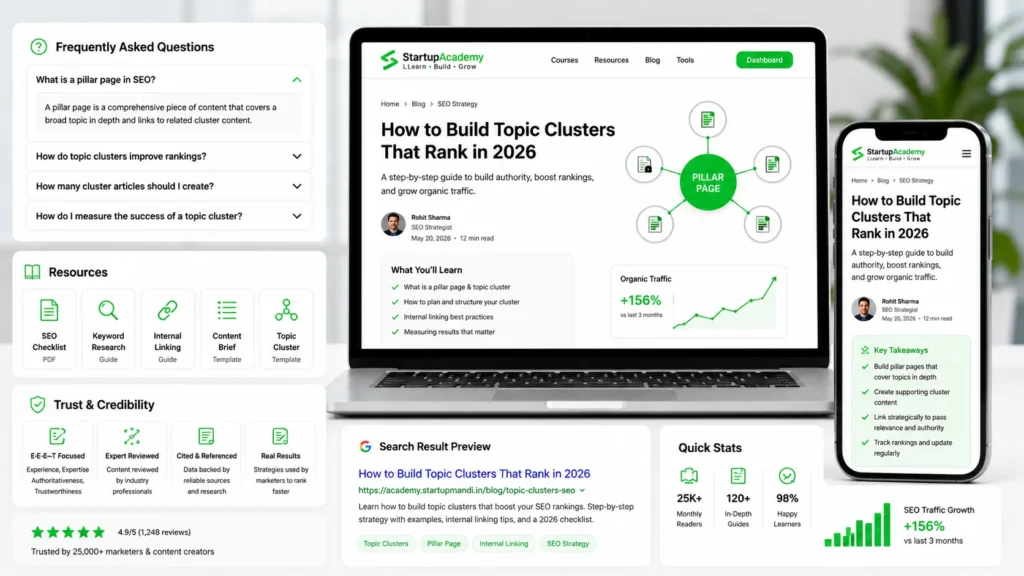
What is SEO content strategy?
It is a structured plan for publishing content that matches search demand, user intent, and business goals.
Why are topic clusters important?
They help search engines understand topical authority and help users navigate related content easily.
How many posts should one cluster have?
Start with one pillar page and 4 to 6 supporting posts, then expand based on demand.
Should every blog target one keyword only?
No. One primary keyword plus related phrases usually performs better than isolated keyword targeting.
What makes a blog post rank faster?
Clear intent matching, strong structure, internal links, descriptive titles, and helpful content all improve the odds.
Do AI Overviews change SEO writing?
Yes. They make concise definitions, question headings, and structured answers more important.
How often should content be updated?
Review important posts regularly and refresh them when search intent, statistics, or examples change.
Can internal links improve conversions?
Yes. They guide readers to deeper resources and relevant offers, which helps move them through the funnel.
Key Takeaways
- A strong SEO content strategy starts with one core topic and expands into clusters.
- Search intent should shape every title, heading, and section.
- Internal linking is both a ranking signal and a user experience tool.
- Question-based headings make your content easier to extract into AI answers.
- Helpful, original, and well-structured content is the safest long-term SEO approach.
Next Steps
Start by choosing one pillar topic that fits StartupAcademy’s audience and expertise. Then build three to five supporting posts around the same theme, and connect them with internal links. If you want a practical next step, the AI-Powered Content SEO Premium Internship Program is a relevant path for learning the workflow in practice.
Conclusion
A good SEO content strategy is not about publishing more. It is about publishing with structure, relevance, and intent. When you build your strategy around topical clusters and strong internal links, each post strengthens the next one and helps your site grow more predictably.
The core of any successful SEO content strategy is this: plan topics as clusters, map intent clearly, and connect everything with internal links that guide readers toward conversions. When you follow this pattern, your strategy becomes scalable and sustainable over time.
For broader marketing execution and campaign integration, the AI-Powered Digital Marketing Internship Program can help you connect your SEO content strategy with paid campaigns, email workflows, and conversion paths. This way, your strategy works not just for search traffic, but for the entire growth funnel.
Few Links Suggestions for more Research & Facts Check
- Google Search Essentials — Official guidance on helpful content and crawlable links.
- Google Helpful Content Guidelines — People-first content principles.
- Semrush Topic Clusters — How cluster SEO works in practice.
- Semrush Blog SEO Tips — Blog formatting and AI visibility guidance.
- HubSpot SEO Strategy — Content planning and publishing structure.