Our Jun2Aug Internship Batches are open. Join Now!

SEO Internship Roadmap For Freshers:

SEO can feel confusing at first, but a SEO internship for freshers gives beginners a simple way to learn by doing. Instead of only reading theory, you get to practice keyword research, on-page SEO, content optimization, and reporting while building real confidence.
Table of Contents
Quick Summary
A beginner-friendly SEO internship works best when it follows a clear learning path. Start with SEO basics, learn the essential tools, practice keyword research, and then move into content, technical fixes, and reporting. If you are a fresher, the goal is not to master everything on day one. The goal is to become useful, learn fast, and build proof of work.
What Is SEO Internship?
An SEO internship is a hands-on training role where you help improve website visibility on search engines. You may work on blogs, keywords, metadata, internal links, technical checks, and performance tracking.
For freshers, this matters because SEO is not just a theory subject. It is a practical skill that improves with repetition, examples, and feedback. Google’s own SEO Starter Guide also makes it clear that the basics can have a noticeable impact when applied correctly.
Why Does It Help Freshers?
A SEO internship for freshers is useful because it shortens the gap between learning and doing. You see how keywords are selected, how pages are optimized, and how rankings are measured in a real workflow.
It also helps you build something recruiters care about: evidence. A fresher with even one small SEO project, a few blog optimizations, and a simple report often stands out more than someone with only notes and certificates.
“If you want to learn SEO, build something and track the results. That proves more than passive study.” — Matt Bailey
How Do Beginners Start?
The easiest way to start is to follow a simple SEO learning path instead of jumping into advanced topics too early. Most beginners make the mistake of trying to learn backlinks, technical audits, and keyword strategy all at once.
A better approach is:
- Understand how search engines work.
- Learn the difference between on-page, off-page, and technical SEO.
- Practice keyword research.
- Optimize a few pages or blog posts.
- Track results in Search Console or Analytics.
That sequence makes the learning feel less overwhelming and more practical.
What Should You Learn First?
SEO Basics
Start with definitions, ranking factors, and search intent. If you understand why Google ranks one page above another, the rest becomes easier.
Keyword Research
This is where SEO becomes useful fast. Learn how to find low-competition keywords, understand user intent, and map keywords to pages.
On-Page SEO
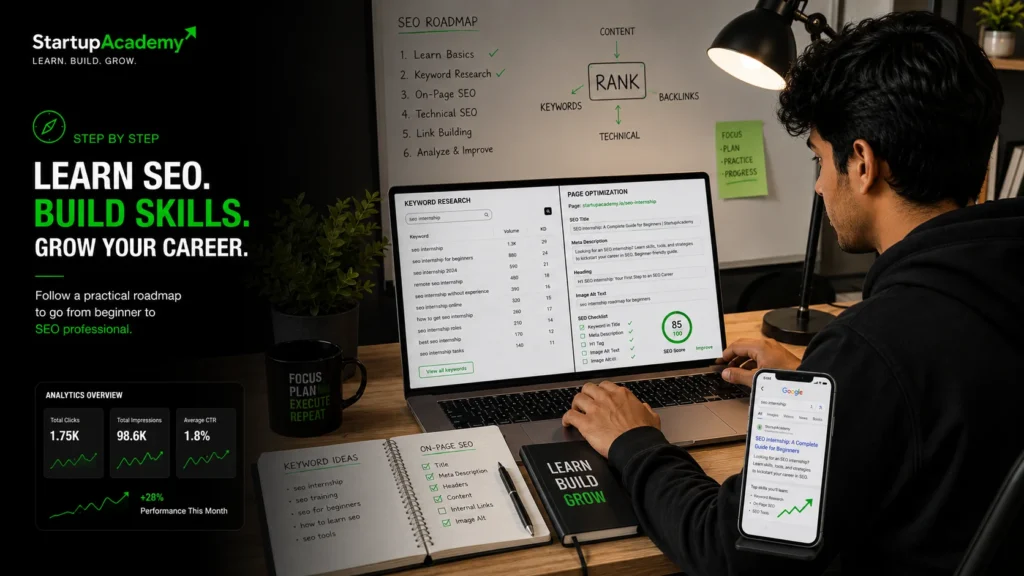
This includes titles, headings, meta descriptions, internal links, image alt text, and content structure. It is one of the most beginner-friendly ways to make a visible improvement.
Which Tools Matter Most?
You do not need ten tools on day one. Freshers only need a small stack that helps them learn, measure, and improve.
| Tool | Why It Matters | Beginner Priority |
|---|---|---|
| Google Search Console | Shows indexing, clicks, and query data | High |
| Google Analytics 4 | Shows user behavior and traffic | High |
| Google Keyword Planner | Helps find keyword ideas | Medium |
| PageSpeed Insights | Checks performance basics | Medium |
| Yoast / Rank Math | Helps with on-page SEO in WordPress | Medium |
| Ahrefs / SEMrush | Useful for deeper research | Low at first |
This tool order matches the practical roadmap used by many beginner SEO programs and internship guides.
How To Build Practice?
A good internship is only half the equation. The other half is practice.
Use this simple framework:
- Pick one website or blog.
- Optimize 3 to 5 pages.
- Write 2 new SEO-friendly articles.
- Connect Search Console and Analytics.
- Review what improved after 2 to 4 weeks.
That is enough to create a beginner portfolio. A real project teaches more than five passive tutorials because it forces you to make decisions and check results.
How To Follow a 90-Day Plan?
Here is a beginner-friendly timeline that works well for freshers.
| Month | Focus | Result |
|---|---|---|
| Month 1 | SEO basics, tools, keyword research, on-page SEO | Understand the foundation |
| Month 2 | Content optimization, WordPress SEO, page speed, reporting | Learn practical execution |
| Month 3 | Technical SEO, case studies, portfolio, applications | Become internship-ready |
This kind of structure is supported by beginner roadmaps that emphasize practice, tools, and consistent application.
How To Learn SEO Fast?
Times Needed: 90 Days, 6 Hours, 0 Minutes
Estimated Cost: USD 0
Description: Learn SEO step by step through basics, tools, content optimization, and real practice so freshers can become internship-ready.
Steps:
- Learn the basics first. Study search intent, ranking factors, and the difference between on-page, off-page, and technical SEO.
- Set up free tools. Connect Google Search Console and GA4, then track clicks, impressions, and user behavior from day one.
- Practice on real pages. Optimize a few blog posts, titles, and internal links so you can see what changes performance.
- Build a simple portfolio. Save screenshots, before-after results, and short notes to show what you improved.
Tools Name: Google Search Console, Google Analytics 4, Google Keyword Planner, PageSpeed Insights
Materials Name: Laptop, website or blog, notes template, keyword list

Why Are Projects Important?
Projects matter because SEO is judged by output, not just knowledge. If you can show how you improved titles, fixed page speed, or found better keywords, your work becomes much easier to explain in interviews.
A project also teaches you how SEO work actually feels in the real world. Sometimes the page does not rank immediately. Sometimes the keyword is too competitive. Sometimes the fix is technical, not content-related. That is normal, and that is exactly why practice matters.
“SEO is not a one-day trick. It is a habit of improving pages, measuring results, and repeating what works.” — Google SEO Starter Guide
What Should a Fresher Portfolio Include?
A good beginner portfolio does not need to be large. It just needs to be clear.
- One optimized blog post.
- One keyword research sheet.
- One before-and-after SEO screenshot.
- One short report on traffic or rankings.
- One small case study with your process.
This is enough to show that you can think like an SEO intern and not just memorize definitions.
How Can StartupAcademy Help?
For beginners who want a guided learning path, StartupAcademy by StartupMandi AI offers internship-style training that combines theory with practice. The AI-powered content SEO and digital marketing programs can help freshers learn through structured tasks instead of random guesswork.
Explore the AI-powered content SEO premium internship program for a focused SEO learning path. You can also compare it with the AI-powered digital marketing internship program if you want a broader skill mix.
What Mistakes Should You Avoid?
Many freshers make the same mistakes:
- Trying to learn advanced SEO before the basics.
- Ignoring Search Console and Analytics.
- Writing content without keyword intent.
- Focusing only on tools and not on practice.
- Waiting too long to start a real project.
These mistakes slow learning, especially for beginners who need clarity more than complexity.
Key Takeaways
- A SEO internship for freshers works best when it is practical, not just theoretical.
- Learn basics first, then tools, then keyword research, then optimization.
- Use Search Console, GA4, and keyword tools to track real progress.
- Build a small portfolio with optimized pages and a short case study.
- Practice matters more than collecting certificates.
Next Steps
- Choose one website or blog to practice on.
- Set up Google Search Console and GA4.
- Optimize three pages this week.
- Write one SEO article with clear keywords.
- Save screenshots and notes for your portfolio.
These steps can turn a beginner into someone who is ready for a real internship faster than passive study alone.
FAQs To Know
What is SEO internship for freshers?
It is a beginner-friendly internship where freshers learn SEO through practical tasks like keyword research, content optimization, and reporting.
Do freshers need experience for SEO internship?
No. Most SEO internships are designed for beginners who are willing to learn and practice regularly.
How long does it take to learn SEO basics?
A focused beginner can understand the basics in a few weeks, but becoming internship-ready usually takes steady practice over 2 to 3 months.
Which tools should beginners learn first?
Google Search Console, GA4, and Google Keyword Planner are the best starting tools.
Can SEO be learned without coding?
Yes. Beginners can learn the core SEO workflow without coding, though basic HTML knowledge helps in technical tasks.
Is SEO a good career for freshers?
Yes. SEO is a strong entry point because it combines content, data, and practical problem-solving.
How do I build an SEO portfolio?
Optimize a few pages, track changes, and document the process with screenshots and short notes.
Where can I find structured SEO learning?
You can start with free guides and then move into guided internship programs like StartupAcademy’s SEO and digital marketing internships.
Conclusion
A SEO internship for freshers is one of the easiest ways to move from theory to real skill. The fastest path is simple: learn the basics, use the right tools, practice on real pages, and build a portfolio that proves your work.
If the goal is to start a real SEO journey, the combination of practice and structured learning works best. Begin with the AI-powered content SEO premium internship program and, if needed, expand into the AI-powered digital marketing internship program.
Few Links Suggestions for More Research & Facts Check
- Google SEO Starter Guide for the official basics.
- Coursera SEO learning roadmap for a beginner-to-expert path.
- How to land an SEO internship for internship prep tips.
- SEO career roadmap for freshers for job-oriented learning.
- How to start your SEO career for a practical real-world approach.